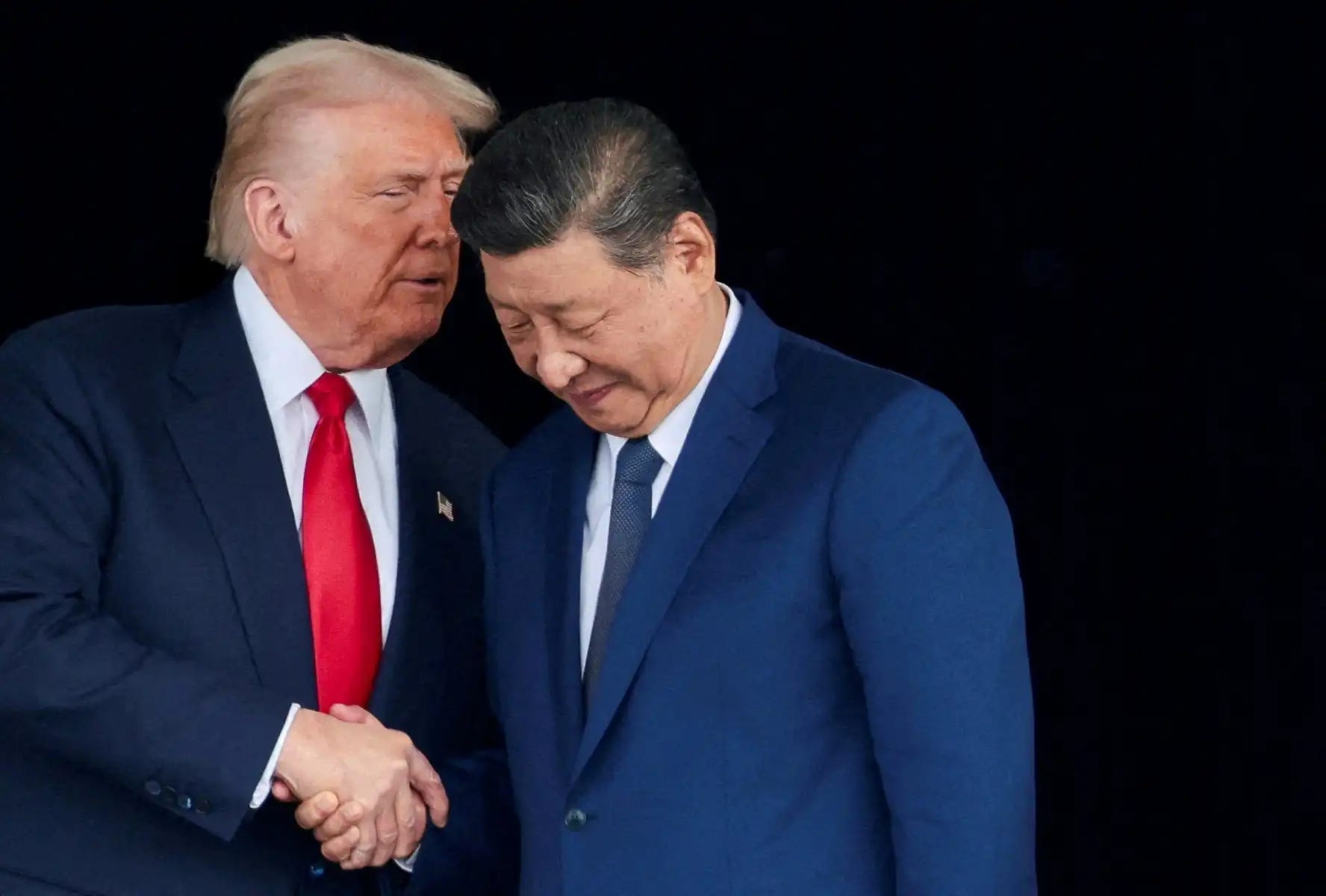
When Donald Trump's wheels touch down in Beijing on May 14, 2026, he will become the first sitting US president to visit China since his own November 2017 trip — and he will arrive on a far weaker footing than when he last met with President Xi Jinping in South Korea just six months ago. The Iran war that delayed this summit by six weeks has done more than rearrange Trump's calendar. It has redrawn the map of leverage.
Munitions stockpiles are half-empty, three carrier groups are pinned in the Persian Gulf, allies refused to send warships to police Hormuz, the Supreme Court gutted his signature tariff weapon in February, and Xi Jinping has spent the interval institutionalizing China as the indispensable hedge for everything Trump cannot fix alone — from Iranian restraint to global energy stability to the rare earths that Patriot interceptors and F-35 magnets cannot do without.
The summit's terms have been shaped in Beijing's favor before Air Force One is wheels-up. Trump still has carrots and sticks. But for the first time in their nine-year acquaintance, the man across the chocolate cake holds the cards Trump needs more than he holds the cards Xi wants.
This assessment draws on Bloomberg, Reuters, the Financial Times, the South China Morning Post, Nikkei Asia, the major Chinese state outlets, TASS and Vedomosti, and roughly two dozen think-tank and journal analyses to map what each side is bringing to Beijing, what each is likely to extract, and what a "successful" summit looks like for two leaders whose definitions of success have rarely overlapped less.
How a six-week delay rewrote the leverage equation
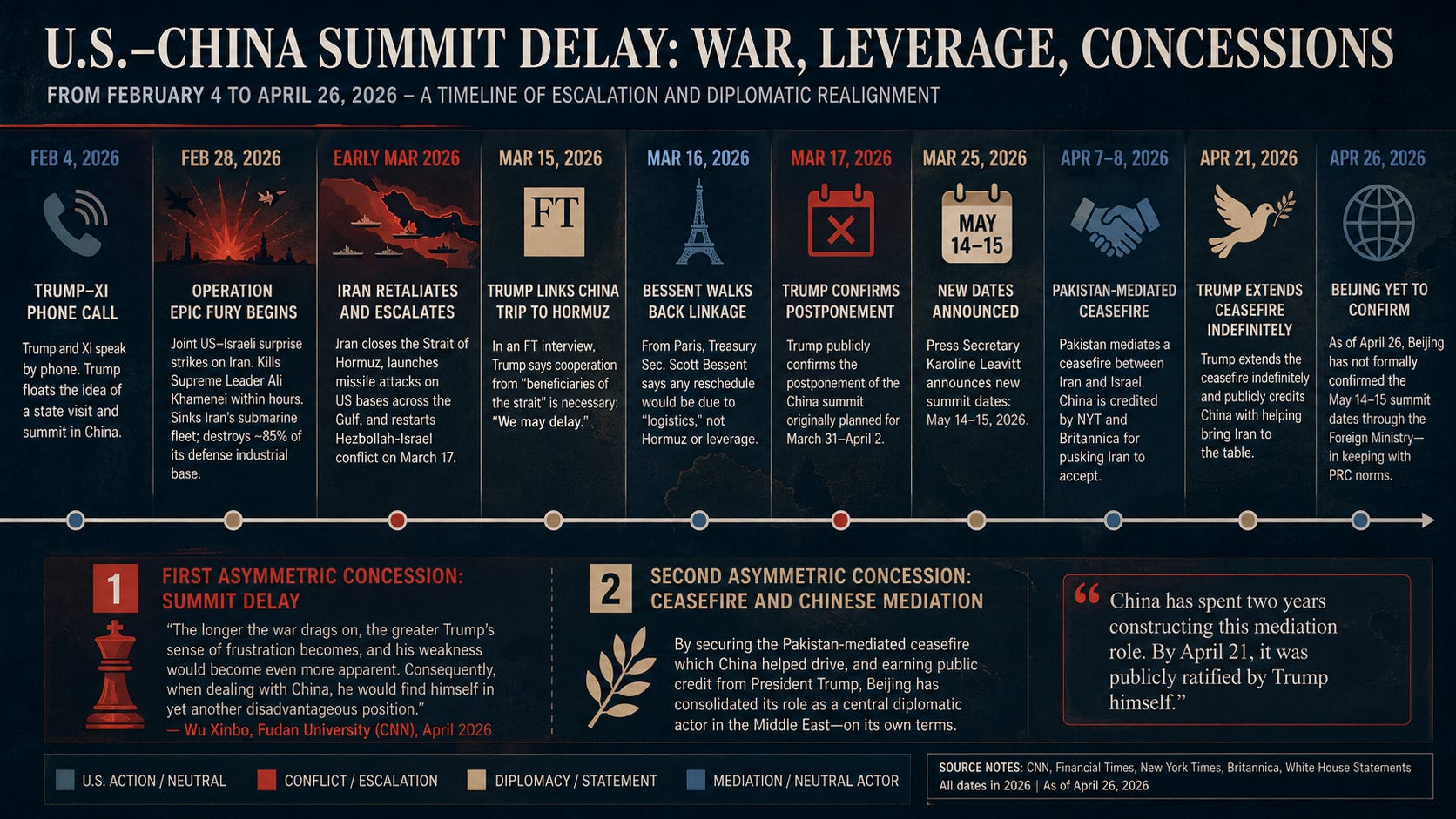
The summit was originally announced for March 31–April 2, 2026, a state visit Trump had floated since his February 4 phone call with Xi. It was scuttled by the war he had not anticipated managing during his trip. Operation Epic Fury — the joint US–Israeli surprise strike campaign that began February 28, 2026 — killed Supreme Leader Ali Khamenei within hours, sank Iran's submarine fleet, destroyed roughly 85% of its defense industrial base, and triggered Iranian closure of the Strait of Hormuz, missile retaliation against US bases across the Gulf, and a Hezbollah-Israel war restart on March 17.
By mid-March, Trump was demanding allied warships to police Hormuz, with the Financial Times publishing a March 15 interview in which he openly tied the China trip to Beijing's cooperation. Treasury Secretary Scott Bessent walked the linkage back from Paris a day later, but the damage was done. On March 17 Trump publicly confirmed postponement; on March 25 Press Secretary Karoline Leavitt announced May 14–15 dates. Beijing has yet to formally confirm them through the Foreign Ministry as of April 26, adding pre-summit ambiguity.
The delay was the first asymmetric concession. CNN's Wu Xinbo of Fudan University put it bluntly: the longer the war drags on, the greater Trump's sense of frustration becomes, and his weakness becomes even more apparent. The April 7–8 Pakistan-mediated ceasefire — which Beijing pushed Tehran to accept — was the second concession. By the time Trump extended that ceasefire indefinitely on April 21, Beijing had been credited by Trump himself with helping bring Iran to the table: an extraordinary public ratification of a Chinese mediation role Beijing has spent two years constructing.
The military overstretch that reshaped the bilateral
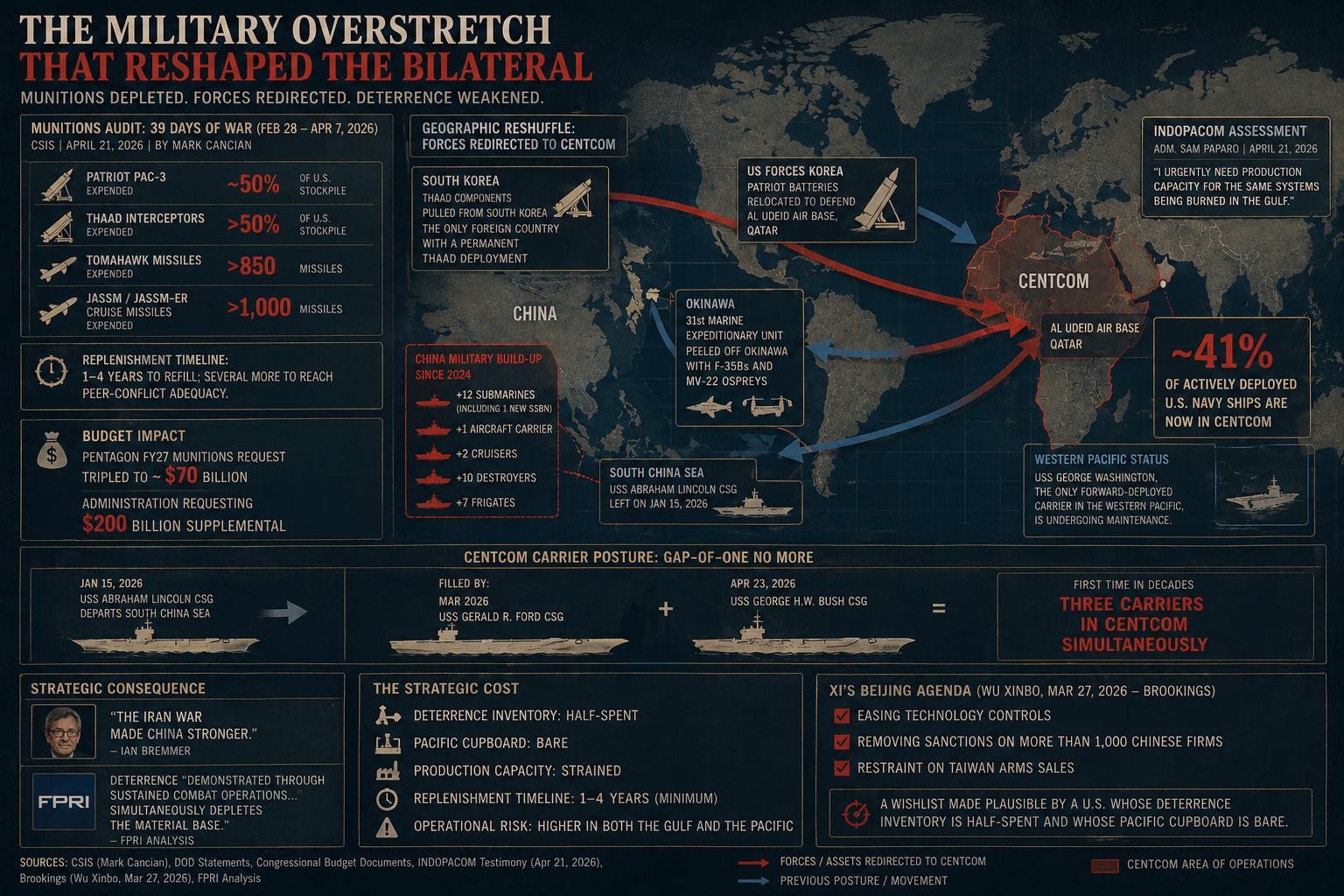
CSIS's April 21 munitions audit by Mark Cancian quantifies the strategic cost. In 39 days, the United States expended roughly half its Patriot PAC-3 stockpile, more than half of THAAD interceptors, over 850 Tomahawks, and more than 1,000 JASSM/JASSM-ER cruise missiles — at a pace requiring one to four years to refill, plus several more to expand to peer-conflict adequacy. The Pentagon's FY27 munitions request tripled to roughly $70 billion; the administration is asking Congress for a $200 billion supplemental.
The geographic reshuffle is starker. THAAD components were pulled from South Korea for redirection to CENTCOM. Patriot batteries from US Forces Korea relocated to defend Al Udeid in Qatar. The 31st Marine Expeditionary Unit was peeled off Okinawa with its F-35Bs and MV-22 Ospreys. Roughly 41% of actively deployed US Navy ships are now in CENTCOM. The USS George Washington, the only forward-deployed carrier in the Western Pacific, is undergoing maintenance.
The Iran war made China stronger.
— Ian Bremmer
That depletion is the structural backdrop of every demand Xi will make in Beijing. When Wu Xinbo lists Beijing's asks — easing technology controls, removing sanctions on more than 1,000 Chinese firms, restraint on Taiwan arms sales — he is itemizing a wishlist made plausible by a US whose deterrence inventory is half-spent and whose Pacific cupboard is bare.
What Beijing will demand: Taiwan, chips, and recognition
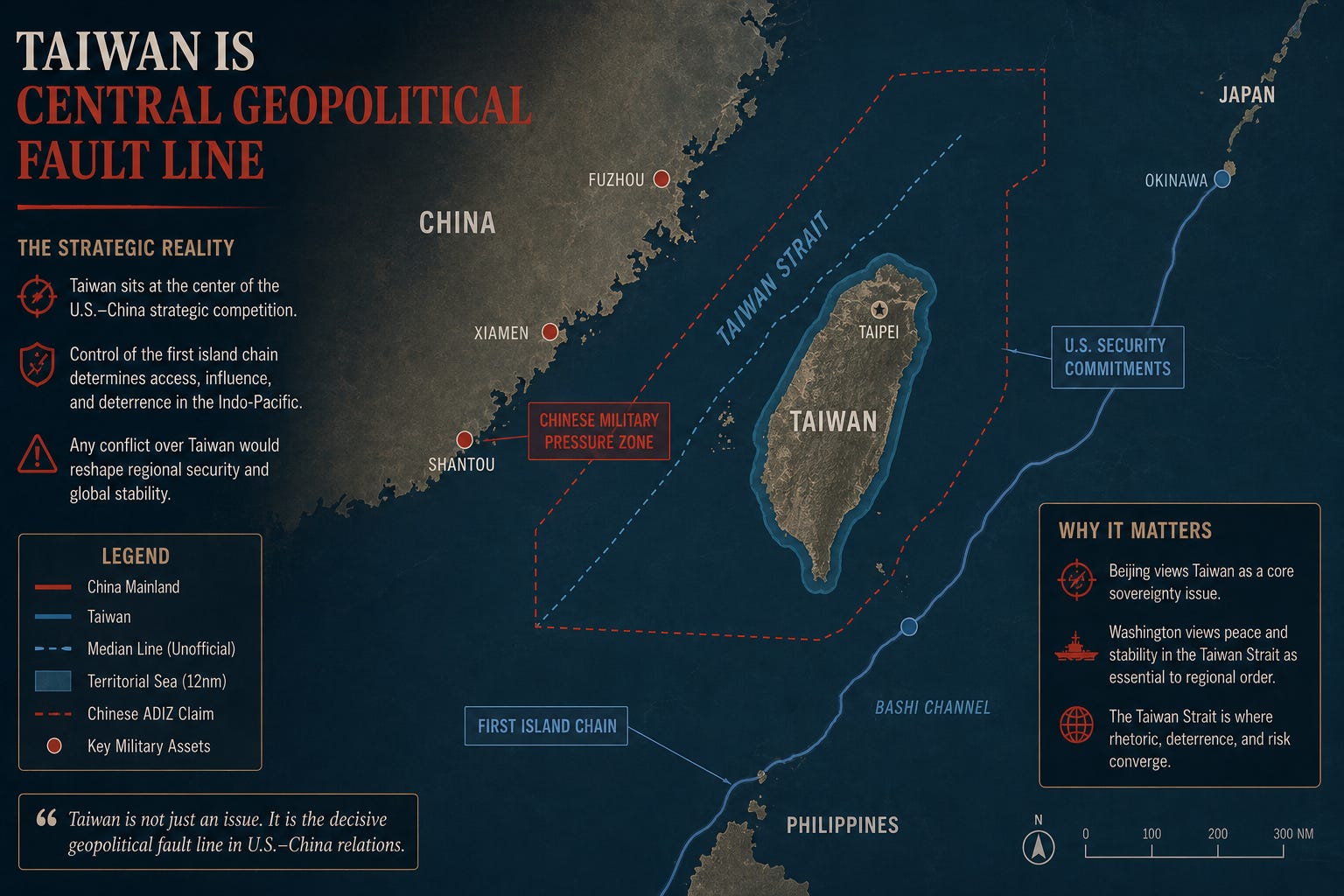
China has been remarkably forthcoming about its priorities. Taiwan is the headline ask. Wu Xinbo, whose Brookings piece functions as a quasi-official Beijing white paper, calls for Trump to make open statements expressing opposition to Taiwan independence and sympathy to China's goal of peaceful reunification — a shift from US "non-support" of independence to US "opposition" that would mark the most significant rhetorical concession on Taiwan since the 1982 communiqué.
Semiconductors are the second-tier ask, and economically the heaviest. Beijing wants the Bureau of Industry and Security entity list trimmed of more than 1,000 Chinese firms; the H200 export licenses extended; B30A (Nvidia's Blackwell-derivative chip designed specifically for China) approved; and the bipartisan MATCH Act blocked. Critically, CXMT — China's leading DRAM and HBM producer — is not yet on the entity list, a gap Beijing wants preserved.
CSIS data underline the asymmetry: China holds 69% of rare-earth mining, 92% of processing, and 93% of magnet production. Brian Wong of HKU floats a "rare-earths-tariff circuit breaker" — a formal binding link between Chinese supply and US tariff levels — as a plausible Beijing proposal.
The fourth tier is secondary-sanctions relief on the Russia-China energy corridor — particularly involving the PipeChina Beihai LNG terminal in Guangxi, which has received eleven-plus cargoes from sanctioned Russian Arctic LNG-2 carriers since August 2025. The UK sanctioned Beihai on October 15, 2025; the United States has conspicuously not, presumably to preserve summit atmospherics. Beijing wants that forbearance institutionalized.
What Trump can credibly extract
Trump's leverage has narrowed but not vanished. His most concrete demand is soybean and Boeing compliance. Reuters' April 16 reporting suggests Beijing may commit to the largest Boeing aircraft order in history — potentially 500 jets — as a pre-summit gesture. Energy is the next layer: Trump wants LNG resumption (Beijing halted US LNG imports in February 2025) and possibly Alaska LNG, plus crude.
Fentanyl precursor enforcement is the third deliverable; the residual 10% fentanyl tariff is the bargaining chip Trump has offered to remove for "definitive and sustained action" — and US fentanyl deaths have already fallen 36.5% in 2024 to 48,422.
What Trump cannot easily wield is the IEEPA tariff hammer. The February 20, 2026 Supreme Court 6–3 ruling voiding his "Liberation Day" tariffs forced a pivot to Section 122 and Section 301 investigations. Asia Society's Wendy Cutler said Trump "has effectively had his wings clipped on his signature economic policy."
The Chinese narrative: stabilizer versus disrupter
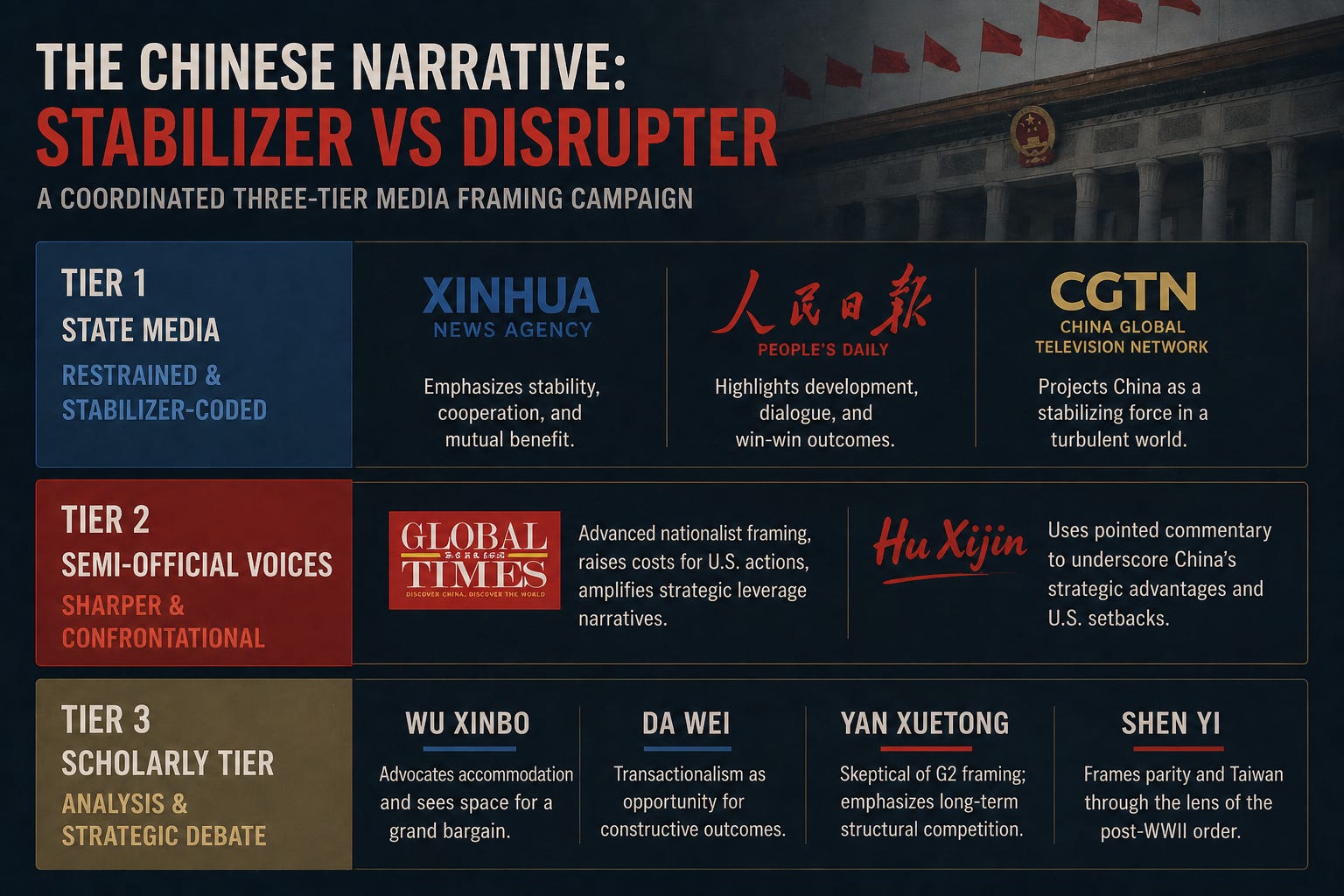
Chinese state media has executed a disciplined three-tiered framing campaign. Xinhua, People's Daily, and CGTN remain restrained and "stabilizer"-coded. The semi-official Global Times pushes harder: after the Supreme Court ruling, former editor Hu Xijin wrote that "Trump has now lost one card, while China still holds all of its cards."
The unifying narrative across all three tiers is "stabilizing on its own terms" — Beijing as the responsible major power against an unpredictable Washington. The April 9–10 Wang Yi trip to Pyongyang, Lavrov's mid-April Beijing visit, China and Russia jointly vetoing the April 7 Bahrain-drafted Hormuz UN Security Council resolution — these are the architecture's load-bearing walls.
The Russian read: weakness ratified, then exploited
Vedomosti reported on April 15 that Putin will travel to Beijing in the week beginning May 18, 2026 — three to five days after Trump leaves. The Kremlin will not officially confirm dates. Diplomatic sources told Vedomosti the visits "are not interconnected in any way" — a denial that itself confirms the choreography. Russian state media is letting the back-to-back stand as silent commentary on China's diplomatic centrality.
Lavrov used his April 14–15 Beijing visit to deliver the Russian thesis with surgical precision: Russia can certainly fill the resource gap that has arisen in China and other countries interested in working together on an equal and mutually beneficial basis. Carnegie's Alexander Gabuev calls this what it is: Russia "the major beneficiary" of Chinese sanctions-circumvention capacity, with the Iran war "strengthening Russia's hand in its relationships with China and India."
What history suggests will happen in the room
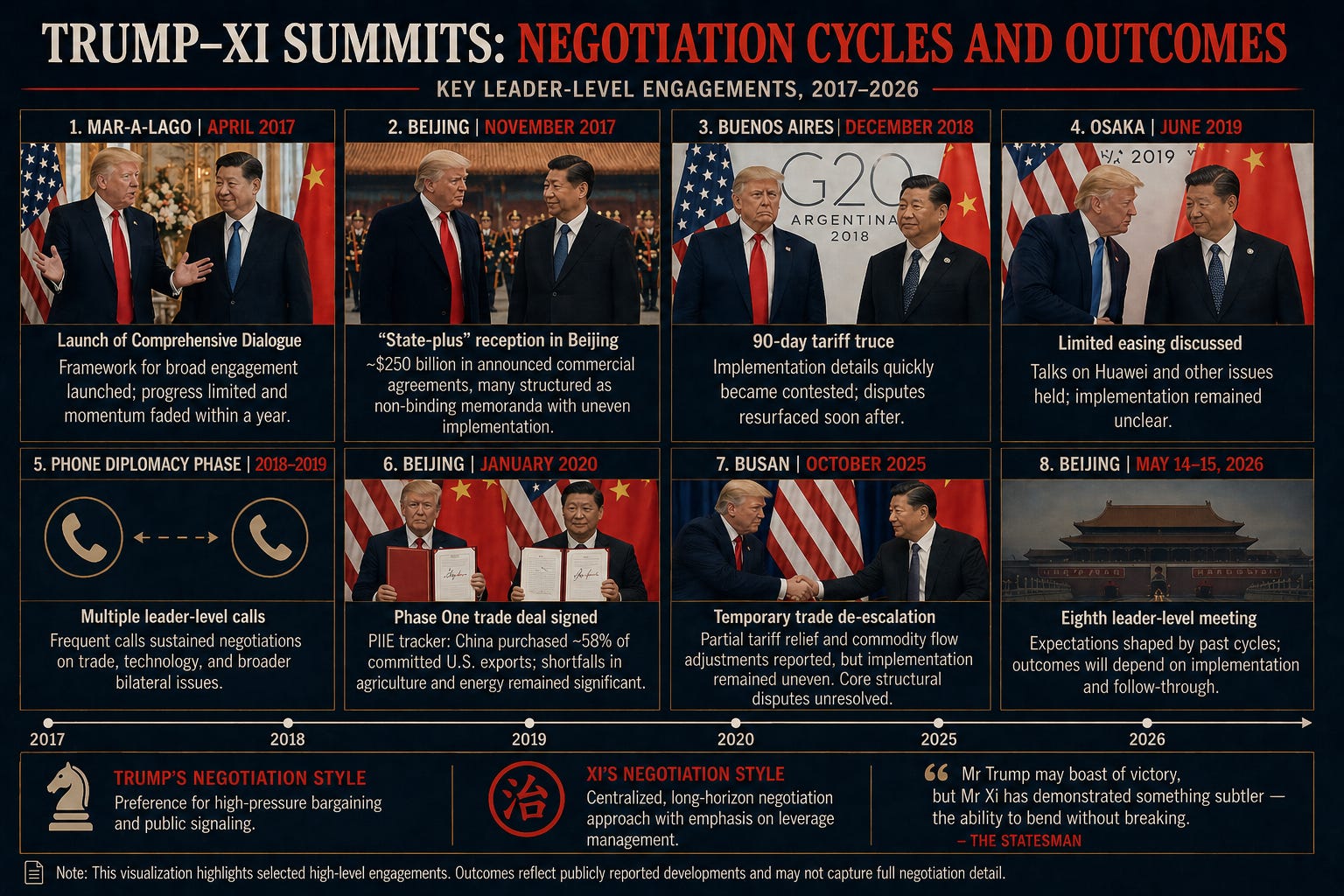
Trump and Xi have met seven times in person; this will be their eighth. The pattern from 2017–2020 and from Busan 2025 is consistent. Mar-a-Lago, April 2017 produced the launch of the Comprehensive Dialogue, collapsed within a year. Beijing November 2017 delivered roughly $253 billion in commercial deal announcements — most of them non-binding MoUs that never materialized. Phase One, signed January 2020: PIIE's tracker found China bought roughly 58% of committed US exports. Busan October 2025 repeated the pattern.
Mr Trump may boast of victory, but Mr Xi has demonstrated something subtler — the ability to bend without breaking.
— The Statesman
Trump's negotiating signature is opening maximalism and theatrical brinkmanship combined with the willingness to walk away and an obsession with personal chemistry. Xi's signature is the inverse: top-down scripted preparation, strategic patience, deliberate ambiguity in readouts, and asymmetric chokepoint-building. The structural problem in Beijing is that Xi can wait longer than Trump can.
The most likely outcome
The base case from analyst convergence is a "Modest Deal / Extended Truce" with roughly 55–65% probability: soybean, sorghum, Boeing, and possibly LNG-Alaska purchases formalized; the rare-earths pause confirmed; some entity-list and Nvidia chip tweaks; an agreement to keep talking through Xi's reciprocal Washington visit and the Florida G20.
A "Dialogue Without Substance" scenario at 25–30% delivers Forbidden City pageantry without deliverables, both sides claiming victory in mutually exclusive terms. A "Big Deal" of comprehensive tariff rollback, Taiwan understanding, and AI-chip framework sits below 10%. Open confrontation or walkout sits below 10%, contingent on Iran.
Trump will define success as headline purchase numbers, photogenic Forbidden City optics, a fentanyl announcement, and the announced reciprocal Xi visit. Xi's success metric is more deeply structural: a public US statement on Taiwan that shifts non-support to opposition; the "mutual respect, peaceful coexistence, win-win cooperation" language entered into a joint readout; chip easing on H20/B30A locked in; no PipeChina or Beihai OFAC designation.
If Xi gets the Taiwan rhetorical movement, Beijing will treat it as the most consequential US concession on the question since 1982 — propagandized in Taipei to weaken Lai Ching-te's coalition before the 2028 elections, and embedded as precedent for Trump's successors. If Trump gives ground there to claim soybeans, the trade will be the worst of his career.
The summit as inflection, not resolution
The May 14–15 meeting will not end strategic competition; it will ratify a recalibration already underway. The deepest signal of how power has shifted is not what Xi will demand at the summit — it is that Wu Xinbo, Da Wei, Hu Xijin, and Wang Yiwei have been allowed to pre-publish Beijing's wishlist in Western outlets, confident enough that Trump will move toward it that they no longer need to negotiate quietly.
The Phase One trade deal of 2020 was extracted from Beijing under pressure and delivered at 58%. The Beijing 2026 deliverables will be extracted from Washington under different pressure, and history suggests the delivery rate will be reversed.
The final irony is the one Trump articulated himself, in his April 15 Truth Social post celebrating the Hormuz reopening: "China is very happy that I am permanently opening the Strait of Hormuz. I am doing it for them, also, And the World… President Xi will give me a big, fat, hug when I get there in a few weeks." In a single post, the President of the United States ratified Beijing's claim to a stake in Gulf security architecture, framed America's costliest war since Iraq as a service to China, and previewed a public embrace from a leader whose central achievement of 2026 will have been doing nothing while America exhausted itself. That is the summit's shape. The hug will come. The question Beijing has already decided is what Trump pays for it.
Sources
- Bloomberg. "Big Take: Trump Arrives in Beijing on a Weaker Footing." April 24, 2026.
- Reuters. Various reports on US–China relations, Iran war developments, and trade negotiations. April 2026.
- Financial Times. Coverage of US requests for allied naval support and China summit dynamics. March–April 2026.
- South China Morning Post. Reporting on Beijing's positioning ahead of the Trump–Xi summit. April 2026.
- CSIS. Cancian, Mark. "U.S. Munitions and the Iran War." April 21, 2026.
- Brookings Institution. Wu Xinbo. Analysis on US–China summit expectations and Taiwan policy. March 2026.
- Carnegie Endowment. Medeiros, Evan. US–China relations and détente framing. 2026.
- Atlantic Council. Hart, Melanie. Analysis of China's strategic positioning. 2026.
- Stimson Center. Sun, Yun. "A Perfect Storm for Taiwan in 2026?" Foreign Affairs, January 2026.
- Hudson Institute. Riboua, Zineb; Cronin, Patrick. Analyses on China strategy. 2026.
- MERICS. "China Forecast 2026." ECFR public opinion survey. ISEAS State of Southeast Asia Survey 2026.
- Peterson Institute for International Economics (PIIE). Phase One trade deal compliance tracker.
- Vedomosti. Reporting on Putin's planned Beijing visit. April 15, 2026.
- TASS. Russian state coverage of US–China relations and Iran war implications. April 2026.